Files are going away. Here's how to manage invisible documents
The very notion of a 'file', that you can see in a hierarchical list of folders, is going away. This happened to me last week when I updated my mind-mapping software, MindNode.
I wanted to open a mindmap that I had been working on earlier that day. So I went to File > Open, expecting to see the neat list of folders that is my Small Business System.
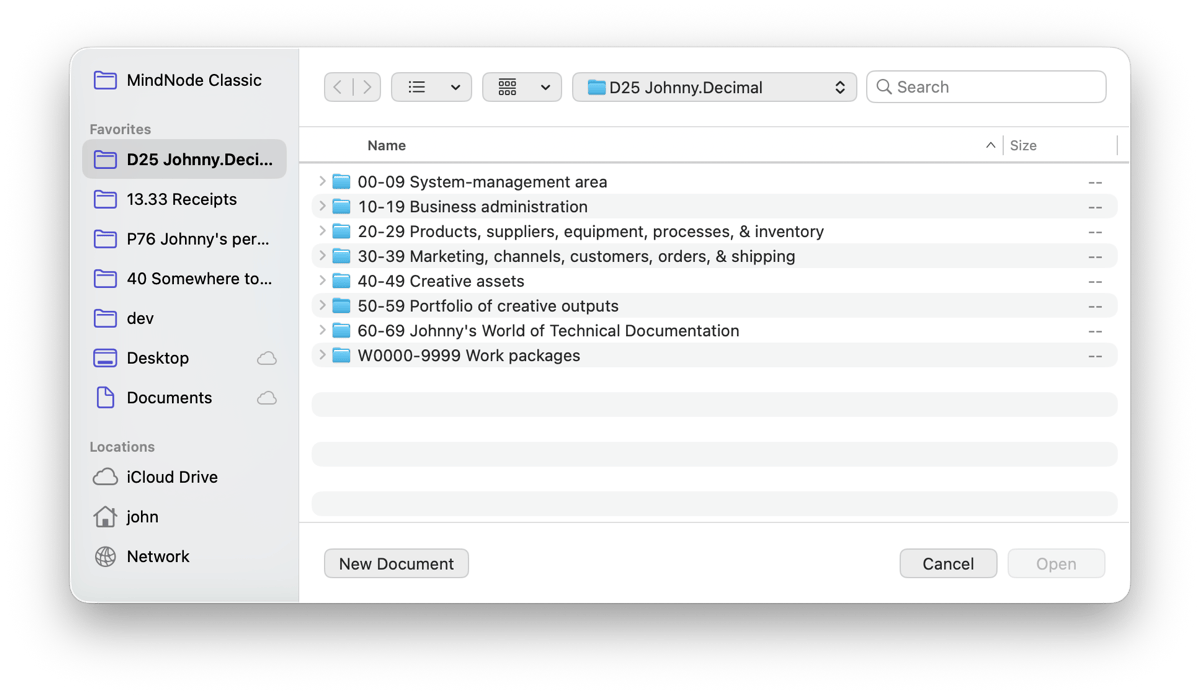
Instead, I was presented with this.
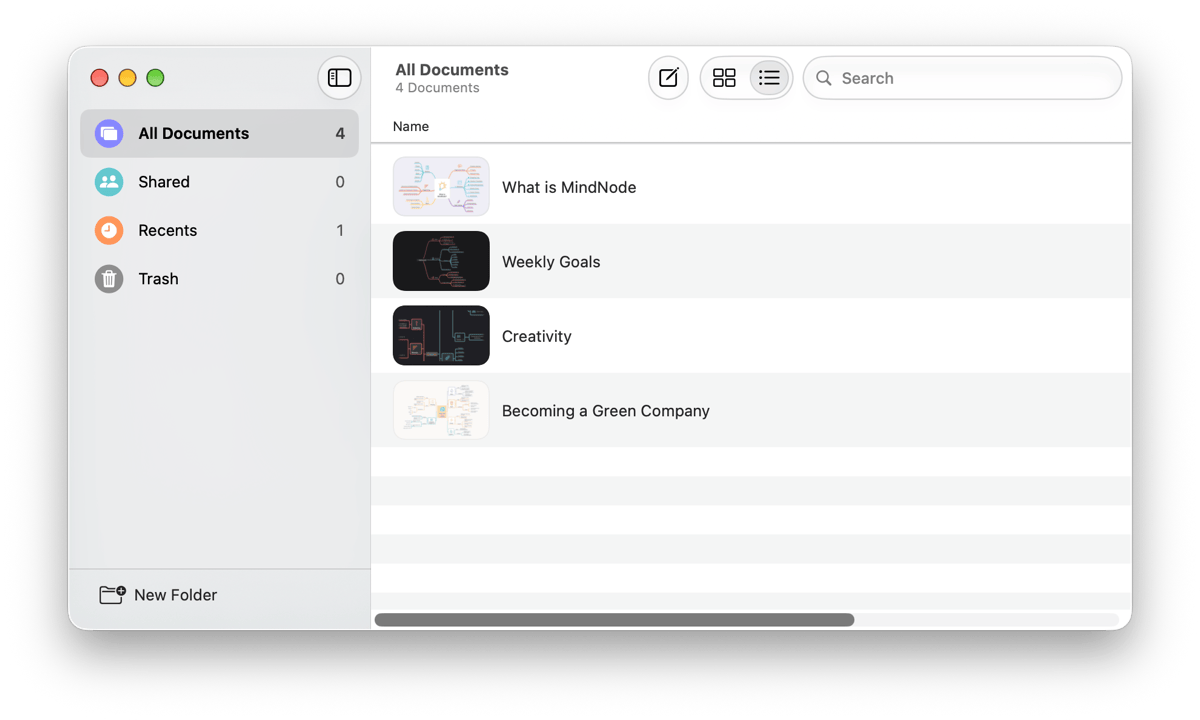
Honestly, I thought it was broken. I clicked File > Open half a dozen times, the same window cascading down my screen, over and over … until it dawned on me. Oh no, I thought. This is just how it is now.
MindNode – and many other apps, I'm not picking on them – have moved to a new 'document model' where everything's managed in the application. In this post and accompanying video (for Pro members), I'll explain what's happening and why, the problems it causes, and give you simple strategies to deal with those problems.
You'd think this would be an existential crisis for Johnny.Decimal. What happens when there are no more files? Isn't organising your files my entire business? In fact, it just makes using a system like mine, where you centralise information management using your JDex, even more important.
The technique I show works just as well if you want to save links to documents stored on a website, in SharePoint, or anywhere else. Read and watch at Files are going away. Here's how to manage invisible documents.
Mindmaps are great for kicking off creative work
For all I knock it in this video, I think MindNode is a great app. It's very important to us: it's how we built the Life Admin and Small Business systems, and how we're developing the upcoming Work System.
Starting a large creative task can be daunting. What do you do, open a new document and stare into the white void? 😱 Chucking a bunch of thoughts into a mindmap is a much gentler start. It's deliberately messy. It's not meant for long-form text, so you can't go too deep. It positively encourages movement of ideas. It's one of the ways we encourage you to build your own system in the Workshop.
MindNode is running a 3-month free trial offer. This is nothing to do with me, and I get no benefit. I just happened to notice it when I launched the app, and thought I'd mention it. Give it a go for a couple of months, see if it can change your workflow.
Editorial policy: no paid endorsements
When I recommend something, I want you to know it's because I think it's the best thing. Not because it's earning me money.
The link above just prompted me to publish our first editorial policy.
I've started to think about managing email…
Talk about big topics. I'm looking forward to this one. Next week will kick off a series on email: from the philosophy of how you should think about it, to very practical tips to help you manage it whether you're at home, or work. (The two require a very different approach. One you largely control. The other, not so much.)
Email shouldn't be a conversation we're still having in 2026. It's already taken enough from us. I can see this turning into a mini-course: it'll appear first on the video feed.
JDex tip: moving IDs, creating pointers
Here's a little trick I use whenever I move an ID from one place to another.
In the Small Business System we have 14.32 External software & services. It's easily our busiest ID, where I've extended the end for each service that we use. We're essentially a software company, so I have almost 50 items there.
I just went looking for my ID for Discord, expecting to find it at 14.52 Websites, blogs, & communities. There is an ambiguity here. Discord could be at either of those locations: it is both an external service and a community.
People cite this as a flaw of Johnny.Decimal, doing the hand-wavey-doomseeker thing that I hate. “But if any specific item has even a remote possibility of being in two places, what's the point in filing anything at all!?!!?1!j!!” 😒
Fortunately I'm of the opinion that you're not a mindless fool, and that you'll figure it out. Mostly it comes down to how you feel. Do I feel that Discord is one of my external services, or do I associate it more with communities? When I created this ID, I chose the former. Now, potentially years later, I look to the latter. Things change.
And that's okay. You shouldn't be afraid to move things. So I just did, moving 14.32+ Discord to 14.52+ Discord. But I think it's valuable – especially in these ambiguous cases – to leave yourself some sort of breadcrumb.
What I do is to leave a note at 14.32, calling it 14.32+ Discord → 14.52. Now if anyone visits there looking for Discord, there's a literal pointer to the correct location. You can leave the note empty – the title does all the work – or you can leave yourself a short note explaining why it's over there, and not here.
(I use Raycast to help me type the arrow, and ▶ all † sorts × of ↑ other ◀ handy characters. It's an amazingly useful tool that I'll be showing Lucy how to use in a video soon.)
AI corner
Continuing the theme, the reason I wanted to find my Discord ID is because I wanted to see if Claude could connect to it and help me find interesting threads for this newsletter.
I use Claude Code, which means that instead of opening the website or app, I jump into a terminal and type claude. What's interesting here is that whenever I'm doing proper work I always launch it from a Johnny.Decimal ID, like this.
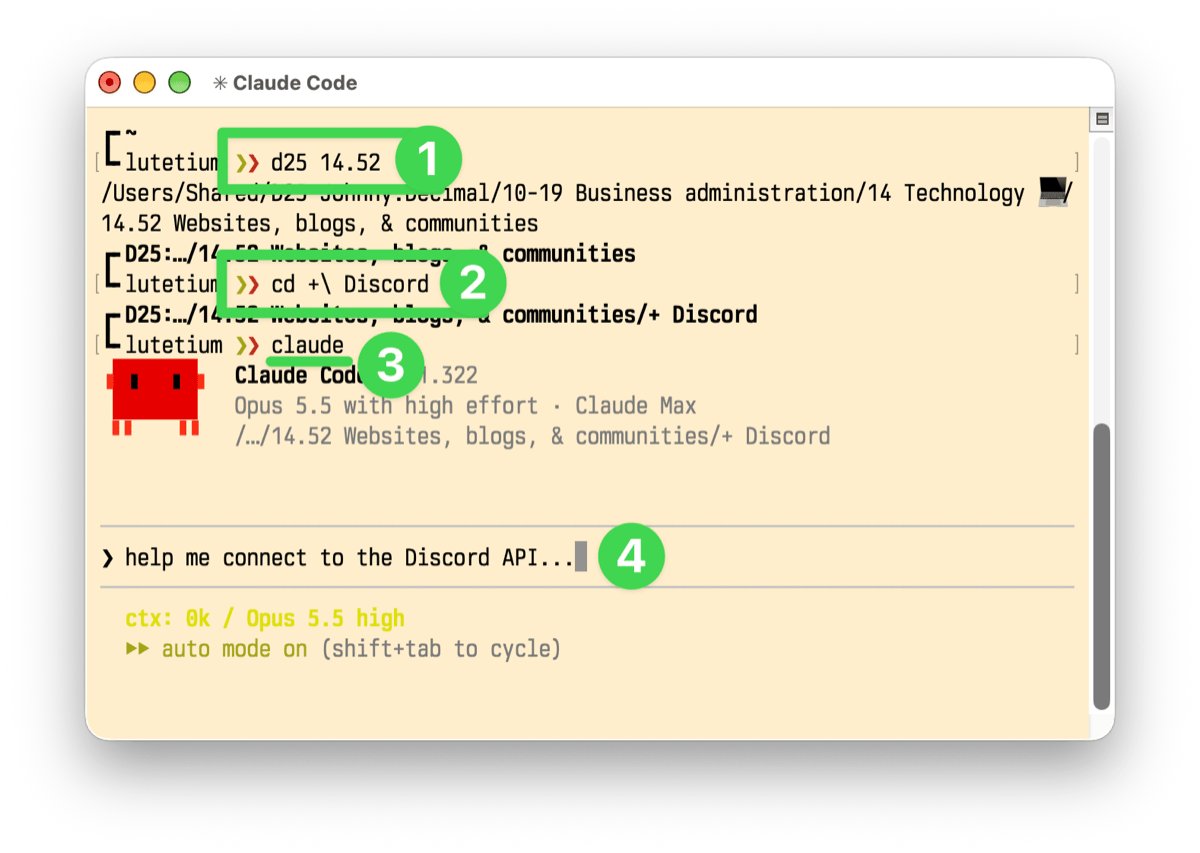
First, I use my command-line tool to jump to folder D25.14.52. Then I cd to the subfolder for Discord, type claude, and start work.
If this is alien to you, and you'd like to learn how it works, let me know! It's not difficult. I've been considering a short 'AI for Small Business' series for a while.
What's interesting here is the act of working in a folder. With this simple act, you get so much 'for free'.
JDex connectivity for free
My JDex skill means Claude immediately knows to reference the JDex entry that corresponds to the ID of the folder it's in. I think of this as your 'shared memory' – keep the stuff in here relevant, and in a language that you, the human, understands.
This way, you could swap out another agent and it'll pick up where the last one left off.
Localised agent memory for free
When you work like this, Claude is writing its own memories and a transcript of your conversation. It uses the folder path as a reference – so if that path remains static, and if you return to the same place to continue a piece of work, you're picking up exactly where you left off.
You can literally say, “last time we…” and it knows exactly what you're referring to. I use this for my travel booking script at 21.15. I launch Claude there, say “process the booking in my inbox please”, and that's it.
This also makes the list of previous conversations with claude --resume neat and focused.
Scripts are filed for free
If Claude creates a script – to connect to the Discord API, for example – it'll create it in this folder. So there's nothing to manage. Everything's already where it needs to be.
I think this really basic work-in-a-folder technique is such a powerful way to use Claude. I see people building these complex 'agent memory' systems and wonder why. Just have neat folders, and be consistent. Job done.
I use this to build tiny local 'apps' like my travel booking thing. We're running a bit long here, so I'll plan this into a future video series. Tell me what problems your small business has that a simple script might automate – don't forget you can just reply to this email.
From northern Japan, where the temperature continues to drop and as we walk the beautiful Kitakami we wonder … do ducks feel the cold? Hit me up if you know the answer.
