Registration review: Taiwan
Vehicle registration plates provide a ubiquitous numbering scheme that's easy to enjoy: just walk around the streets and pay attention. Each country offers its own variant of the form, so in this series I will review each country's registration plates as I encounter them.
These reviews are not scientific and should not be quoted as authoritative.
Introduction
Taiwan's scheme was refreshed in 2012. This review only considers the post-refresh scheme. Older plates are still very common.
Schema
A simple, consistent scheme: AAA-0000. The usual suspects are omitted from the letter prefix – O, I – but Q remains, as we'll see below.
Absurdly, the number 4 is no longer used. I thought this was user preference, as I did see one in the wild. But it seems that the user preference was so strong, they elected to remove it. The plate I saw must have been from an older range.
This broad omission of 4 is common across Asia – it sounds like the word 'death' – as is the equally absurd omission of the West's superstition, 13.1 (Combined with the fact that the ground floor is represented as 1 means that a room on the 14th floor isn't quite as high as one might hope.)
The scheme allows a theoretical maximum of 24^3 × 9^4 = 90,699,264 plates. Given Taiwan's population of 23.5m people this is a touch under 4 cars each. This doesn't feel like enough, but the most recent plate I saw began CCD indicating that about 10% of plates have been issued in 14 years. So we don't need to worry about them running out.
Special cases
There are special cases for electric vehicles E__-____, rentals R__-____, and so on. I appreciate this additional information being encoded in the plate.
They've also removed a whole bunch of three-letter words from the pool so bad luck if you wanted GAY-0000. Inexplicably, ANT is disallowed. Because that's … an ant?
Issue date
The scheme encodes issue date gracefully: it's pretty obvious by looking at cars that they started at AAA and they're currently somewhere in the early-to-mid-C__s.
This avoids issues of specifically encoding a year into the plate, as we'll see the next time I visit the UK. It also provides a free street game: find the latest plate!
Region awareness
There appears to be no region encoding in the plate. Taiwan is a relatively small island so this probably isn't necessary, but I do like knowing where someone is from.
Schema: 4/5
- Pro: simple, obvious, and consistent.
- Con: no regional coding, the
4thing, and it feels punitive to have excludedANT.
Design
A simple plate, stamped metal, black on white in its standard form. I prefer an embossing over a cheaper-looking laminate so top marks here.
The typeface is slightly condensed which looks nice on the plate. But I like a plate to fill the space given for it on the vehicle, and a narrow plate rarely does that.
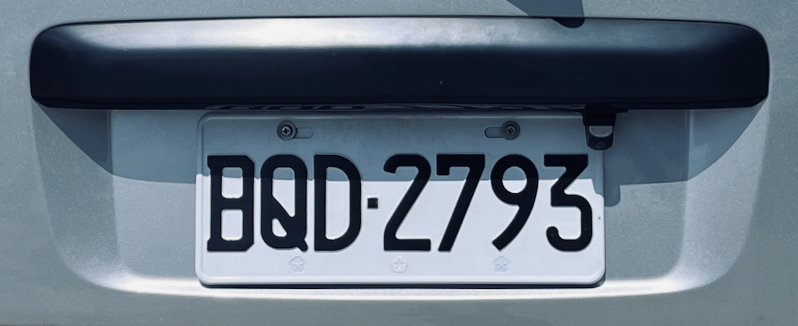
Theoretically that's a - dash separating the letters and numbers, but it's shown as a dot on most (all?) plates. I would have stretched that out a little, at least on cars where there's plenty of room.
Points for a nice Q
If you're going to use a Q you really have to make sure it looks like a Q. Taiwan is a clear pass in this category.
Markings at the bottom
Apparently they moved the screw holes exclusively to the top to allow for those markings, barely visible, at the bottom. I wouldn't have bothered.
Design: 3/5
- Pro: stamped metal. A nice typeface.
- Con: no other adornments. Kinda plain. Doesn't fill the space.
Summary
Overall Taiwan scores 7/10: not bad for our first entrant. It's an inoffensive plate that does the job without trying to get in your face. I just wish that they'd put a touch more into its design.
Footnotes
-
13is not excluded from the registration scheme, to be clear. I refer to its common omission from building floor numbers. ↩